Coach Approach vs Motivational Interviewing
Key differences, shared ground, and a clinical decision framework for healthcare professionals
Overview
One of the most common questions I hear when introducing healthcare professionals to the Coach Approach is:
- How is the Coach Approach different from motivational interviewing (MI)?
- I have MI training — should I also take training in the Coach Approach?
- When should cognitive behavioural therapy (CBT), MI, and the Coach Approach each be used with clients or patients?
This article answers all three questions, with a primary focus on distinguishing the Coach Approach from MI, as these two share the most overlap.
For a visual comparison of CBT, MI, and the Coach Approach in healthcare, the PowerPoint presentation slides are available at: functionfirstcoaching.com/resources.
What is a Coach Approach in Healthcare?
A Coach Approach in Healthcare is a semi-structured conversation any healthcare or helping professional can use within their existing role. It is a way of asking questions that helps a patient or client identify their own barriers, articulate what matters to them, and build an action plan that supports sustained behavioural change they direct.
At its core, a Coach Approach in Healthcare is four things working together:
- A dialogue rooted in curiosity rather than immediate problem-solving
- A questioning method that activates the other person’s own insight
- A goal-setting process that builds ownership and follow-through
- A clinical framework for addressing the perceptual barriers — fear, low self-efficacy, and self-limiting beliefs — that stall progress even when the clinical work is solid
— Hélène Thériault, 2026
What is Similar?
First and foremost, both motivational interviewing (MI) and the Coach Approach use communication as their methodology, facilitating behavioural change through a semi-structured dialogue between the client or patient and the clinician.
Both require the development of complex skills that are honed through considerable practice over time (Miller & Rollnick, 2023; Cook, Greene, & Maxwell, 2024). A key shared skill is accurate empathy, which goes beyond simply reflecting what was heard, enabling the client to articulate their own reasons for change (or not).
ACCURATE EMPATHY
a foundational skill for the helping professions
An active effort to understand and interpret the other person’s view of their situation — their internal perspective of it.
— Adapted by Hélène Thériault from Miller, W. R. (2018)
Both approaches are client-centred, emphasising rapport-building, collaboration, and active listening as key components of facilitating change. When compared to the Dive Into a Coach Approach® framework, both follow a four-step process that provides structure to the flow of the conversation.
Healthcare practitioners may find MI and the Coach Approach particularly adaptable, as both can be integrated into other therapeutic approaches such as harm reduction, skill building, and occupational engagement.
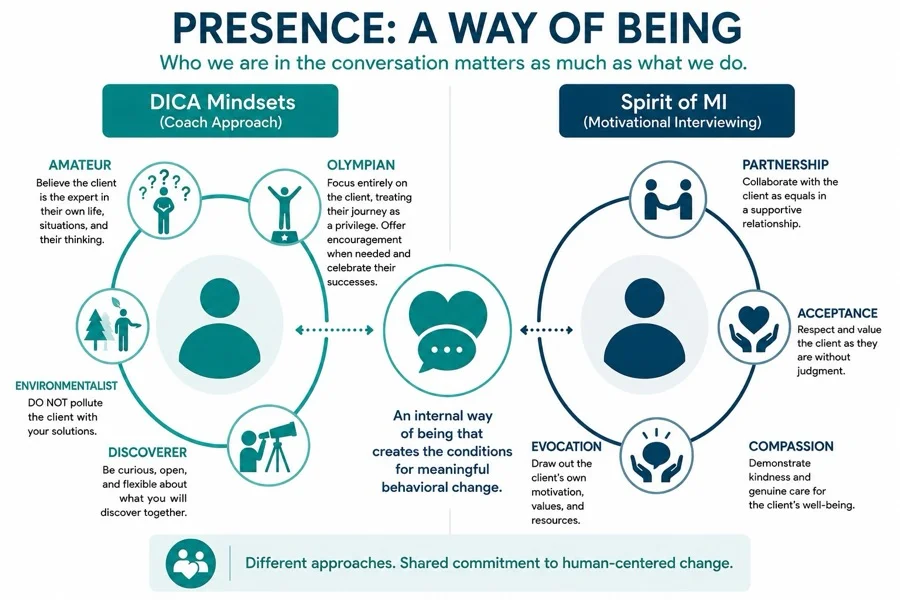
Finally, both approaches emphasise a way of being. In motivational interviewing, this is known as the Spirit of MI, grounded in four key elements: partnership, acceptance, compassion, and evocation (Miller & Rollnick, 2023). Similarly, the Dive Into a Coach Approach® Mindsets encapsulate the International Coaching Federation (ICF) core competencies into four ways of being metaphors: Amateur, Environmentalist, Olympian, and Discoverer (Thériault, 2020).
What is Different?
Comparatively, the Coach Approach is a comprehensive practice model that can be used both formally as an intervention and informally as an approach (Pentland et al., 2016; Perlman & Moain Abu Dabrh, 2020). Unlike MI’s focus on ambivalence, the Coach Approach dives deeper, working from the inside out to create lasting transformation.
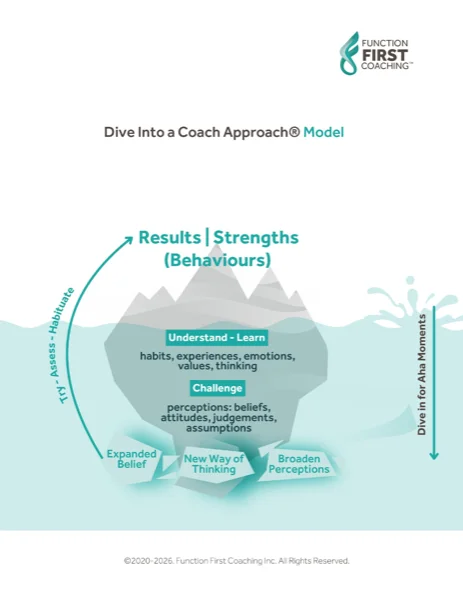
This deeper work focuses on shifts in perception — including beliefs, attitudes, judgments, and assumptions — which in turn influence behaviour and decision-making (Reynolds, 2020). Because this approach requires a stronger foundation in ways of being, advanced techniques, and more sessions, it supports clients in making sustained behavioural changes (Graham et al., 2021).
Furthermore, the partnering approach inherent in this communication style actively engages the client in developing the skills needed to self-manage their condition. This long-term engagement not only supports individuals in managing chronic illness but can also play a critical role in preventing disease by fostering proactive health behaviours.
Similarities & Differences — An Overview
Using the scuba diving metaphor from Dive Into a Coach Approach® training, clinicians choose their approach based on the client’s needs:
Motivational Interviewing (MI)
- The clinician snorkels just below the surface when a client faces a specific problem or dilemma but is reluctant to take action.
- MI provides a guiding communication style to help the client explore their reasons for change (or not) while remaining near the surface of the iceberg.
The Coach Approach
- When a deep-seated belief or perception prevents the client from progressing toward their rehabilitation goals, the clinician dives deeper beneath the surface of the iceberg.
- This approach supports clients in challenging perceptions, exploring the underlying thinking that shaped the issue, and fostering sustained behavioural change.
Synergy Between Motivational Interviewing & the Coach Approach
While MI and the Coach Approach are distinct, they can work together in a complementary way:
- MI helps resolve ambivalence, while the Coach Approach supports deeper perceptual and behavioural transformation.
- MI is typically short-term (1 to 2 sessions), focused on exploring readiness for change, while the Coach Approach is longer-term (6+ sessions), allowing for sustained self-discovery and action.
- Both approaches prioritise client autonomy but differ in depth. MI guides clients through their reasons for change, while the Coach Approach supports long-term integration of new ways of thinking and acting.
By integrating coaching into healthcare, clinicians can:
- Enhance client and patient satisfaction
- Reduce burnout and improve clinician retention
- Shift healthcare from a curative model to a preventative one
“It seems simple until you try it.”
— Miller, W. R. (2018)
Accurate empathy is deceptively straightforward to describe and genuinely difficult to practise — and that is exactly what makes it worth developing.
Coach Approach & Cognitive Behavioural Therapy
Interested in how the Coach Approach can complement CBT? Our article, Coach Approach & CBT: A Synergistic Approach, explores how integrating coaching principles with CBT can be blended for improved patient outcomes. Co-authored with Lara Desrosiers, MScOT, OT Reg. (Ont.), from AMPS Healthcare Education.
Together, the Coach Approach and CBT create a powerful synergy — deepening client outcomes while reducing therapist burnout.
Ready to Explore the Coach Approach?
Dive Into a Coach Approach® (DICA) Level 1 is designed for healthcare professionals who want to integrate coaching into their clinical practice. Start with the fundamentals — no prior coaching experience required.
Learn About DICA Level 1 →References
Cook, E., Greene, G. J., & Maxwell, J. (2024). Coaching for person-centred healthcare: A solution-focused approach to collaborative care (1st ed.). Taylor & Francis Group. https://doi.org/10.4324/9781003414490
Graham, F., Kennedy-Behr, A., & Ziviani, J. (2021). Occupational performance coaching: A manual for practitioners and researchers. Routledge.
International Coaching Federation. (2021). ICF core competencies. https://coachingfederation.org/app/uploads/2021/07/Updated-ICF-Core-Competencies_English_Brand-Updated.pdf
Miller, W. R. (2009). Ten things motivational interviewing is not. Behavioural and Cognitive Psychotherapy, 37, 129–140.
Miller, W. R. (2018). Listening well: The art of empathetic understanding. Wipf and Stock Publishers.
Miller, W. R., & Rollnick, S. (2023). Motivational interviewing: Helping people change and grow (4th ed.). Guilford Press. https://www.guilford.com/books/Motivational-Interviewing/Miller-Rollnick/9781462552795
Pentland, W., Isaacs-Young, J., Gash, J., & Heinz, A. (2016). Enabling positive change: Coaching conversations in occupational therapy. CAOT Publications ACE.
Perlman, A., & Moain Abu Dabrh, A. (2020). Health and wellness coaching in serving the needs of today’s patients: A primer for healthcare professionals. Global Advances in Health and Medicine, 9, 1–8.
Reynolds, M. (2020). Coach the person, not the problem: A guide to using reflective inquiry. Berrett-Koehler Publishers.
Thériault, H. (2026). Dive Into a Coach Approach® 1.0 Participant Workbook. Unpublished.