About Dive Into a Coach Approach®
Dive Into a Coach Approach® (DICA) is a healthcare-specific coaching education program created for healthcare and helping professionals. It teaches practical coaching mindsets, frameworks, and techniques that help professionals lead conversations that build ownership, participation, and meaningful action.
The DICA program is organized as a stackable learning journey through three levels of the Coach Approach in Healthcare Certificate Pathway:
- Level 1 – Professional Certificate (20 hours; self-paced)
- Level 2 – Practitioner Certificate (30 hours; hybrid)
- Level 3 – Integration Certificate (10 hours; hybrid)
Together, these three levels form a 60-hour stackable certificate pathway. The levels are designed to build progressively through education, practice, feedback, and real-world application. Learners can progress one level at a time, earning a distinct certificate and digital badge at each level.
Depending on the course or certificate level, learners may also earn International Coaching Federation (ICF) Continuing Coach Education credits, American Occupational Therapy Association (AOTA) continuing education units, and National Board for Health & Wellness Coaching (NBHWC) continuing education credits.
The Dive Into a Coach Approach® (DICA) program was created for the realities of healthcare and helping professions rather than adapted from a generic coaching curriculum. The examples, practice situations, and application questions reflect conversations with patients, clients, service users, families, colleagues, and teams.
The DICA program is designed to help you integrate a Coach Approach with the professional expertise you already have. It offers:
- A flexible starting point and a level-by-level journey rather than an all-at-once commitment
- Practical tools you can apply in brief, blended, or extended conversations
- Guided practice, peer coaching, and individualized competency feedback as you progress
- Healthcare-specific attention to professional role, scope, documentation, and real-world implementation
- Continuing education opportunities approved by the International Coaching Federation (ICF), American Occupational Therapy Association (AOTA), and National Board for Health & Wellness Coaching (NBHWC), depending on the course or certificate level
- Instruction led by Hélène Thériault, BScOT, MAdEd, MCC – an occupational therapist, adult educator, ICF Master Certified Coach, and recipient of the 2023 ICF Coaching Impact Award for Emerging Coach Educator
Stackable means you can build your education, practice, and recognition one level at a time. Levels 1–3 each lead to a distinct Coach Approach in Healthcare certificate and digital badge. After completing the three certificate levels, learners who want to pursue the International Coaching Federation (ICF) Associate Certified Coach (ACC) credential can continue to Level 4 – ICF Readiness & Mentorship. Level 4 supports readiness to apply through the ACC Portfolio Path.
| Stage | What it includes | Cumulative hours | Recognition / purpose |
|---|---|---|---|
| Goal Achieved – Level 1 20 hours, self-paced |
| 20 hours | Coach Approach in Healthcare Professional Certificate and digital badge |
| Second Nature – Level 2 30 hours, hybrid |
| 50 hours | Coach Approach in Healthcare Practitioner Certificate and digital badge |
| Into Practice – Level 3 10 hours, hybrid |
| 60 hours | Coach Approach in Healthcare Integration Certificate and digital badge |
| Level 4 – ICF Readiness & Mentorship 10 hours, hybrid |
| — | Readiness to apply for the International Coaching Federation (ICF) Associate Certified Coach (ACC) credential through the Portfolio Path |
Important: Completing DICA Levels 1–4 provides the 60 hours of coach-specific education and 10 hours of mentor coaching required for an ACC Portfolio Path application. Mentor coaching and competency-based Growth Feedback are woven throughout Levels 2–4 rather than delivered as a separate block. Learners must also meet the ICF requirements in effect when they apply, including coaching experience, skills verification, the ACC Exam, and application requirements. ICF makes the final credentialing decision.
Getting started and continuing
If you are new to the Dive Into a Coach Approach® (DICA) program, begin with Goal Achieved – Level 1. It is a 20-hour, self-paced program delivered in two parts:
- DICA 1.0 Core Fundamentals – 12 hours
- Coaching Tools for Healthcare Bundle – 8 hours
If you want to experience the methodology before committing to Level 1, you can begin with the introductory Dip Your Toe module.
Completed Core Fundamentals through MedBridge? You do not repeat it. Complete the eight-hour Coaching Tools for Healthcare Bundle to earn Goal Achieved – Level 1. The same applies if you completed Core Fundamentals through another approved Function First Coaching route.
Yes, you can move through the pathway one level at a time. You do not need to commit to the full pathway at the beginning.
You may begin Second Nature after completing Core Fundamentals and finish the self-paced Coaching Tools for Healthcare Bundle alongside your live cohort. However, Second Nature does not replace the remaining Goal Achieved requirements. Both Goal Achieved and Second Nature must be completed before the Practitioner Certificate and Level 2 digital badge are awarded.
The Coaching Tools for Healthcare Bundle is available for one year from registration, giving you flexibility to complete it at a pace that works for you.
Second Nature – Level 2 is offered once each year from September through December. Exact cohort dates, session times, and registration details are published on the Upcoming Events page and the Second Nature page.
Live classes are recorded and remain available during the course access period. Second Nature also includes eight hours of peer coaching with your peer coaching partner; you and your partner schedule those sessions at times that work for both of you. One peer coaching session is recorded and submitted for individualized Growth Feedback aligned with the International Coaching Federation (ICF) Core Competencies.
The live learning, peer coaching, and feedback make Second Nature a practice-based experience rather than only a knowledge-based course.
The SDI 2.0 (Strength Deployment Inventory, Second Edition) is a validated relational intelligence assessment included in Second Nature. You receive a personalized assessment and participate in a facilitated cohort debrief; both are included in tuition.
The SDI 2.0 helps you understand your motivational values, how you respond to conflict, and how your strengths can become overdone under pressure. For leaders, it makes patterns in difficult conversations more visible. For clinicians and other helping professionals, it connects directly to coaching presence by showing the strengths you naturally bring into conversations and where overdone strengths may affect how you engage with others.
In an age of AI-assisted healthcare, distinctly human capabilities such as understanding motivation, adapting communication, navigating conflict, and building trust are becoming increasingly important. The SDI 2.0 helps you develop the relational awareness needed to use these capabilities with greater intention.
Certificates, badges, and continuing education
The first three levels each lead to a distinct stackable certificate and matching digital badge:
- Goal Achieved – Coach Approach in Healthcare Professional Certificate
- Second Nature – Coach Approach in Healthcare Practitioner Certificate
- Into Practice – Coach Approach in Healthcare Integration Certificate
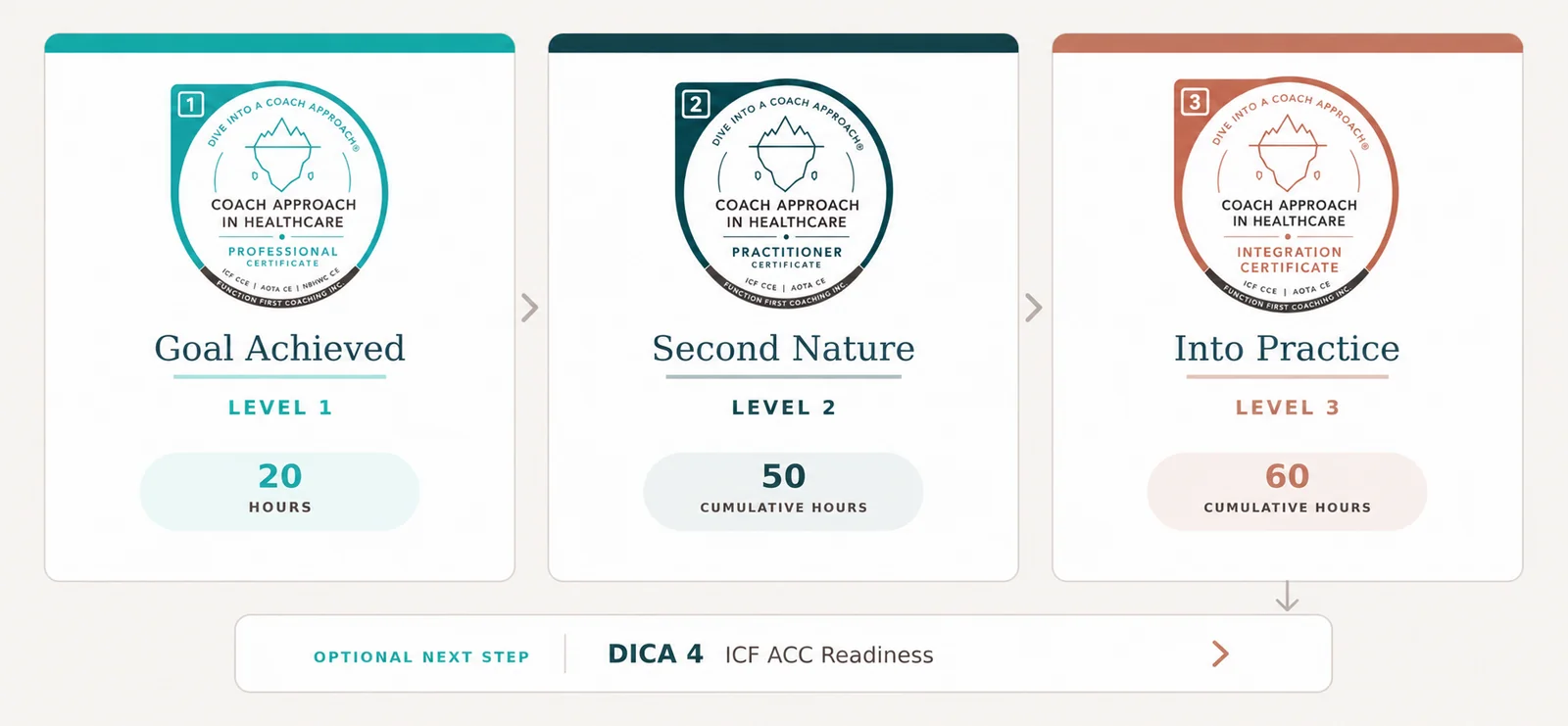
The digital badge carries the same name as the certificate it represents. You can list an earned certificate on your CV or résumé and display the corresponding digital badge in your email signature, LinkedIn profile, or website.
Level 4 supports readiness to pursue the Associate Certified Coach credential and does not award an additional Coach Approach in Healthcare certificate or digital badge.
The Coach Approach in Healthcare certificates do not include post-nominal letters. They sit alongside your existing professional designations. Credentials awarded separately by the International Coaching Federation (ICF), including Associate Certified Coach (ACC), Professional Certified Coach (PCC), and Master Certified Coach (MCC), have their own post-nominal letters once earned.
The Dive Into a Coach Approach® (DICA) program combines coach-specific education and mentor coaching with professional continuing education approvals. The detailed breakdown is below.
Coach-specific education and International Coaching Federation (ICF) Continuing Coach Education (CCE)
| Stage | Coach-specific education and mentor coaching | ICF CCEs and ACC Portfolio Path contribution |
|---|---|---|
| Goal Achieved – Level 1 | Coach-specific education: 20 hours, self-paced
| 20 CCEs
|
| Second Nature – Level 2 | Coach-specific education: 30 hours, hybrid
Mentor coaching: one individual mentor-coaching session | 20 CCEs
Plus 10 additional coach-specific education hours |
| Into Practice – Level 3 | Coach-specific education: 5 additional hours Mentor coaching:
| Not issued as ICF CCEs. Counts as coach-specific education toward an ACC Portfolio Path application:
|
| Level 4 – ICF Readiness & Mentorship | Total program time: 10 hours, hybrid Coach-specific education:
Mentor coaching:
| Not issued as ICF CCEs. Counts as coach-specific education toward an ACC Portfolio Path application:
|
| Complete DICA program: Levels 1–4 | 60 hours of coach-specific education
Mentor coaching: at least 10 hours, documented separately and woven throughout Levels 2–4 | 40 CCEs
Plus 20 additional coach-specific education hours and at least 10 hours of mentor coaching |
International Coaching Federation (ICF) Continuing Coach Education (CCE) credits are identified separately from additional coach-specific education hours. The additional hours are not issued as ICF CCEs; they are intentionally designed to support the 60-hour coach-specific education requirement for an Associate Certified Coach (ACC) Portfolio Path application.
Learners receive supporting curriculum documentation to submit with their application, and DICA graduates have successfully used this documentation in their ACC Portfolio Path applications. ICF reviews each application and makes the final determination regarding the acceptance of education hours and credential eligibility.
American Occupational Therapy Association (AOTA) and National Board for Health & Wellness Coaching (NBHWC) continuing education approvals
| Stage | AOTA continuing education | NBHWC continuing education |
|---|---|---|
| Goal Achieved – Level 1 | 2.0 CEUs total
| 19 continuing education credits total
|
| Second Nature – Level 2 | 2.0 CEUs Approval applies to 20 of the 30 coach-specific education hours | 2.5 continuing education credits Integrating Mindfulness into Coaching and Healthcare |
| Into Practice – Level 3 | 1.0 CEU | — |
| Level 4 – ICF Readiness & Mentorship | — | — |
| Complete DICA program: Levels 1–4 | 5.0 CEUs | 21.5 continuing education credits
|
Upon completion, learners receive a detailed certificate of completion identifying the course, completion date, education hours, and applicable continuing education approvals. This documentation may be submitted to a regulatory college, licensing board, professional association, credentialing body, or employer for consideration toward continuing professional development or renewal requirements. Acceptance varies by profession and jurisdiction, so learners should confirm the requirements with the appropriate organization.
They may be able to apply Dive Into a Coach Approach® (DICA) education toward their professional development or continuing education requirements. Acceptance and submission processes vary by profession, state or province, and regulatory body.
Learners receive a detailed certificate of completion and supporting course information that can be submitted for individual review where permitted. Learners should confirm eligibility with their licensing board, regulatory college, or professional association before applying the hours toward renewal or registration requirements.
Using a Coach Approach in your role or practice
Each certificate level develops a different depth of knowledge, practice, application, and feedback:
| Certificate level and learning outcome | Matching digital badge |
|---|---|
Goal Achieved – Level 1 (20 hours total; self-paced) Includes the 12-hour Core Fundamentals course and the eight-hour Coaching Tools for Healthcare Bundle. Completing Core Fundamentals alone builds foundational awareness of the Dive Into a Coach Approach® (DICA) model, framework, mindsets, and techniques, but does not earn the Level 1 Professional Certificate or prepare you to offer independent coaching services. After completing both components, you earn the Coach Approach in Healthcare Professional Certificate and digital badge. Many learners integrate a Coach Approach into an existing clinical, leadership, education, or organizational role. | 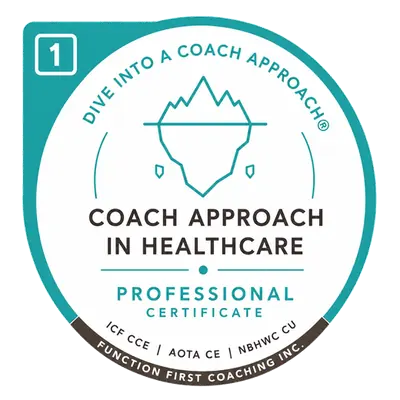 |
Second Nature – Level 2 (30 hours; hybrid) Deepens your coaching skill through live learning, peer coaching, coaching demonstrations, individualized Growth Feedback, mindfulness and embodiment learning, and the Strength Deployment Inventory (SDI 2.0) relational intelligence assessment. Upon completion, you earn the Coach Approach in Healthcare Practitioner Certificate and digital badge. | 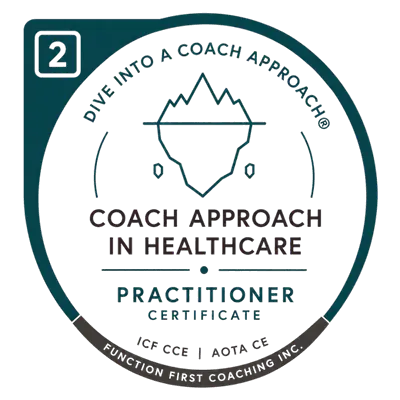 |
Into Practice – Level 3 (10 hours; hybrid) Supports the integration of your learning through six extended client coaching sessions, mentor coaching, and competency-based feedback. Upon completion, you earn the Coach Approach in Healthcare Integration Certificate and digital badge. | 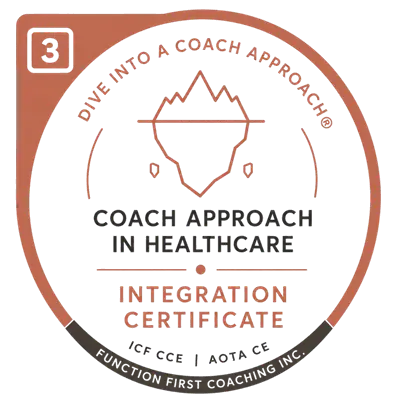 |
Level 4 – ICF Readiness & Mentorship (10 hours; hybrid): Completes the coach-specific education and mentor coaching hours provided across the full pathway. It supports graduates in preparing to pursue the International Coaching Federation (ICF) Associate Certified Coach (ACC) credential through the Portfolio Path. Level 4 does not award an additional Coach Approach in Healthcare certificate or digital badge.
Explore: Level 4 – ICF Readiness & Mentorship →
Completing Level 4 does not automatically confer the ACC credential. Learners must meet the International Coaching Federation (ICF)’s remaining coaching-experience, skills-verification, examination, and application requirements. The International Coaching Federation makes the final credentialing decision.
No. Coaching and therapy can both involve purposeful conversation, but they have different aims, responsibilities, and professional boundaries. Coaching is a collaborative process that helps a person clarify what matters, explore possibilities, and take meaningful action. Therapy addresses clinical, rehabilitation, or mental health goals within the practitioner’s professional scope and plan of care.
Guideline 3 of the Dual Role Professional Practice Guidelines describes a Coach Approach as a semi-structured, coaching-informed conversation that healthcare or helping professionals may use within their existing role. It may include open-ended questions, reflective listening, exploring what matters to the person, identifying barriers, and supporting personally meaningful action. Using a Coach Approach does not change the practitioner’s role, scope of practice, or professional responsibilities.
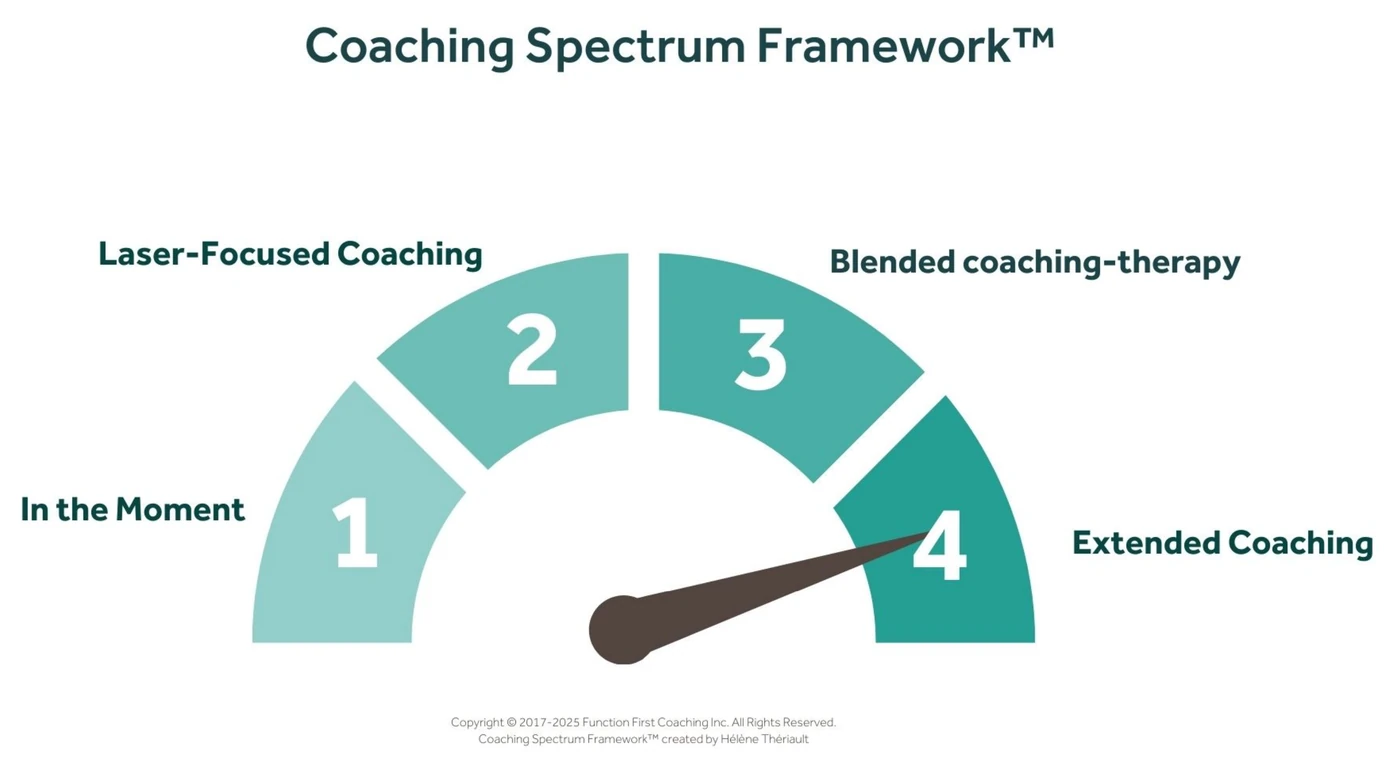
The Coaching Spectrum Framework™ helps learners distinguish among in-the-moment, laser-focused, blended therapy-coaching, and extended coaching conversations. Within this framework, blended therapy-coaching means using coaching-informed methods while remaining in the healthcare professional role. It does not mean providing two separate professional services simultaneously.
Not automatically. You may accurately state the Coach Approach in Healthcare certificate you have earned. Whether you can describe yourself as a coach or offer paid coaching outside your existing professional role depends on your demonstrated competence, professional scope, the service you intend to offer, how you represent that service, and the jurisdictions in which you and your clients are located.
Core Fundamentals is the first 12-hour component of Goal Achieved – Level 1. Completing Core Fundamentals alone does not earn the Coach Approach in Healthcare Professional Certificate. Completing the full 20-hour Goal Achieved program earns the Level 1 certificate and digital badge. Goal Achieved is designed primarily to help healthcare and helping professionals integrate a Coach Approach into an existing clinical, leadership, education, or organizational role. Function First Coaching does not position Level 1 alone as preparation for establishing an independent paid coaching practice.
Knowledge of a coaching framework is different from demonstrating coaching competency through practice, observation, feedback, client application, and mentor coaching. These developmental opportunities are progressively incorporated into Second Nature – Level 2, Into Practice – Level 3, and Level 4.
Completing the full Dive Into a Coach Approach® (DICA) program, Levels 1–4, provides a much stronger foundation for independent coaching and supports graduates preparing to pursue the International Coaching Federation (ICF) Associate Certified Coach (ACC) credential through the Portfolio Path. However, completing the DICA program or earning a DICA certificate does not, by itself, provide legal authorization to practise, expand or change a regulated scope of practice, guarantee liability insurance coverage, or award an International Coaching Federation credential.
Before offering coaching outside your existing professional role, consult your regulatory body or professional association, your liability insurer, and, when needed, a legal adviser familiar with the jurisdictions involved.
Licensed health professionals in the United States may also find attorney Barbara Zabawa’s article helpful as general educational information:
Read: The Dual-Role Dilemma — How Licensed Health Professionals Can Safely Wear Two Hats →
When a team learns together, the value goes beyond individual skill development. Clinicians build a shared coaching language and begin applying a Coach Approach more consistently in real workplace conversations.
If your organization already subscribes to MedBridge, team members can complete the DICA 1.0 Core Fundamentals content through the Coach Approach Foundations in Healthcare Certificate Program. Function First Coaching can then support the team’s workplace application through the DICA Team Q&A Series.
The Dive Into a Coach Approach® (DICA) Team Q&A Series includes a discovery call and three live, customized sessions focused on your patient population, workplace culture, clinical scenarios, barriers, and successes. It is available for teams of up to 30 participants. Current pricing and inclusions are outlined in the Team Training One-Pager. MedBridge course access is arranged separately through your organization’s MedBridge subscription.
For organizations that do not use MedBridge, or that need training for larger groups, multiple teams, direct delivery, the complete Goal Achieved – Level 1 program, or a deeper multi-level implementation, Function First Coaching offers customized options. Download the Team Training One-Pager and book a 20-minute inquiry call so we can determine the best fit for your goals, structure, schedule, and budget.
Coach Approach in Healthcare training is available directly through Function First Coaching and through select education partners.
Function First Coaching: Choose from three self-paced starting points:
- Dip Your Toe - DICA 1.0 Module 1 provides a 90-minute introduction for $49 USD. If you decide to continue, your $49 is applied toward your next step.
- DICA 1.0 Core Fundamentals is the complete 12-hour foundational course. It can be completed on its own, but it does not independently earn the Level 1 Professional Certificate.
- Goal Achieved - Level 1 is the complete 20-hour, self-paced program. It combines the 12-hour Core Fundamentals course with the eight-hour Coaching Tools for Healthcare Bundle and leads to the Coach Approach in Healthcare Professional Certificate and digital badge.
- MedBridge: MedBridge subscribers can access the Coach Approach Foundations in Healthcare Certificate Program. It includes the 12-hour DICA 1.0 Core Fundamentals course series along with supplemental MedBridge content. The Core Fundamentals component provides the first 12 hours of Goal Achieved. Learners can then complete the eight-hour Coaching Tools for Healthcare Bundle through Function First Coaching to earn Goal Achieved – Level 1.
- American Occupational Therapy Association (AOTA): AOTA members can access the complete 20-hour Coach Approach in Healthcare Professional Certificate through the AOTA Store with AOTA member pricing. This is the complete Goal Achieved – Level 1 program and includes both Core Fundamentals and the Coaching Tools for Healthcare Bundle.
- Embodia: Allied healthcare professionals can complete the 20-hour Goal Achieved - Level 1 program through a live, cohort-based experience. Completion leads to the Coach Approach in Healthcare Professional Certificate and digital badge.
Formats, cohort dates, pricing, access periods, and the amount of live learning vary by provider. Review the details of each option to choose the route that best fits your profession, schedule, and preferred learning format.
Already completed Core Fundamentals? Complete the eight-hour Coaching Tools for Healthcare Bundle to finish Goal Achieved – Level 1 and earn the Coach Approach in Healthcare Professional Certificate and digital badge.
Preparing for an International Coaching Federation (ICF) Associate Certified Coach (ACC) credential
The Associate Certified Coach (ACC) is the first credential level awarded by the International Coaching Federation (ICF). The Portfolio Path is available to applicants whose coaching education includes ICF Continuing Coach Education (CCE) courses, non-ICF-accredited coach-specific education, or a combination of both, rather than one complete ICF-accredited Level 1 or Level 2 program.
The complete Dive Into a Coach Approach® program, Levels 1–4, is structured to support an ACC Portfolio Path application. It provides 60 hours of coach-specific education, consisting of 40 ICF CCE credits and 20 additional coach-specific education hours. It also provides at least 10 hours of mentor coaching, documented separately and woven throughout Levels 2–4.
The additional coach-specific education hours are not issued as ICF CCE credits. Function First Coaching provides completion and curriculum documentation that learners can submit with their Portfolio Path application. ICF reviews each application and makes the final determination regarding the acceptance of education and mentor-coaching hours and overall credential eligibility.
| ICF ACC Portfolio Path requirement | How the Coach Approach in Healthcare program supports it | What the learner completes |
|---|---|---|
| 60 hours of coach-specific education | Levels 1–4 provide 60 hours: 40 ICF CCE credits plus 20 additional coach-specific education hours. Supporting completion and curriculum documentation is provided. | Complete Levels 1–4 and submit the required certificates and curriculum documentation. ICF makes the final determination regarding acceptance. |
| 10 hours of mentor coaching completed over at least three months, including at least three individual hours | At least 10 hours of mentor coaching from qualified mentors are documented separately and woven throughout Levels 2–4. The program includes individual and group mentor coaching, observed practice, and competency-based Growth Feedback. | Complete the required live sessions, individual sessions, recorded coaching submissions, and documentation requirements in effect when applying. |
| 100 coaching-experience hours with at least eight clients, including at least 75 paid hours and 25 hours completed within the 18 months before applying | The six extended client coaching sessions completed during Into Practice – Level 3 may count when they meet ICF’s definition and documentation requirements for coaching experience. | Continue coaching beyond the program as needed and document the remaining experience hours, paid hours, recency requirement, and number of clients. |
| Competency-verification requirements in effect when applying | Practice, observation, individualized Growth Feedback, client application, and mentor coaching are progressively integrated throughout Levels 2–4. Level 4 supports ACC readiness and competency development. | Complete the competency-verification and supporting documentation required by ICF at the time of application. |
| ACC Exam and Portfolio Path application | The curriculum develops understanding and application of the ICF Core Competencies. Level 4 provides application-readiness and exam-preparation support. | Pass the ICF ACC Exam and submit the Portfolio Path application, fees, and supporting documentation directly to ICF. |
Important 2027 transition: ICF has announced that, beginning January 1, 2027, new mentor-coaching hours used for ICF credential applications must be completed with a mentor coach who holds the Mentor Coach Specialization (MCS). For ACC Portfolio Path applications submitted on or after April 1, 2027, the enhanced mentor-coaching process will include at least three observed and reviewed coaching sessions and an ICF Competency Review Form. This process will replace the separate ACC performance evaluation.
Function First Coaching will support learners in meeting these updated requirements by coordinating mentor coaching, observed-session reviews, and required competency documentation with qualified mentors who hold the ICF credentials and specializations required at the time the services are delivered.
Mentor coaching is woven throughout Levels 2–4 rather than delivered as a separate block. Across these levels, learners complete 10 hours of mentor coaching over at least three months, including at least three hours of individual mentor coaching. At least three coaching sessions are observed and reviewed, allowing learners to receive progressive, competency-based Growth Feedback throughout their journey.
Questions and support
Email our team at info@functionfirstcoaching.com. Tell us what Coach Approach in Healthcare education you have completed and where you completed it, including through MedBridge, the American Occupational Therapy Association (AOTA), Embodia, or Function First Coaching. Let us know what you hope to do next, and we will help you identify the most relevant next step, certificate level, or team-training option.
Ready to begin?
Start with the introductory Dip Your Toe module, or begin the 20-hour Goal Achieved – Level 1 program.
Last reviewed: August 2026